Crate training is often misunderstood as a form of confinement or punishment. When approached with patience, empathy, and positive reinforcement, a crate becomes a natural safe haven for your dog. Canines are instinctively den animals that seek out small, enclosed spaces when they want to rest, recharge, or seek comfort during stressful moments like thunderstorms. Establishing a crate as your dog’s personal sanctuary simplifies housebreaking, prevents destructive chewing, and ensures safe travel. This comprehensive guide walks you through a humane, progressive method for crate training that prioritizes your dog’s psychological well-being.
Understanding the Purpose of Crate Training
Before introducing your dog to a crate, it is vital to establish the correct mindset. The goal is never to lock a dog away for convenience or to penalize them for bad behavior. Instead, you are giving them a dedicated space where they feel completely secure.
Key benefits of successful crate training include:
-
A natural reduction in separation anxiety by creating a safe space for solitude
-
Faster, more effective housebreaking due to a dog’s natural instinct not to soil their sleeping area
-
Enhanced safety during unsupervised moments, protecting your dog from ingesting toxic household items or dangerous objects
-
Reduced stress during vet visits, grooming sessions, or emergency evacuations
-
Simplified travel, ensuring your pet is secure in moving vehicles
Choosing the Right Crate for Your Dog
Selecting the proper equipment sets the foundation for a positive training experience. Crates come in several styles, each serving distinct needs based on your lifestyle and your dog’s personality.
Types of Crates
-
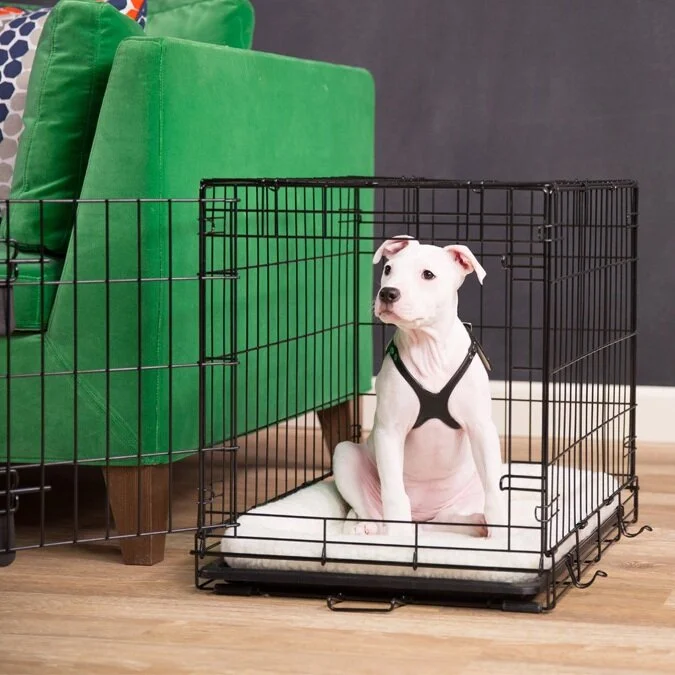
Wire Crates: Excellent for airflow and visibility. Many models come with divider panels that allow you to expand the interior space as your puppy grows.
-
Plastic Travel Crates: Cosier and darker, offering a more traditional den-like feeling. These are ideal for dogs that get easily overstimulated by visual triggers.
-
Fabric or Soft-Sided Crates: Lightweight and portable, perfect for travel or calm dogs that are already fully trained.
-
Furniture-Style Crates: Wooden or composite enclosures that double as end tables, blending seamlessly into home decor.
Finding the Correct Size
Size is the most critical factor. The crate must be large enough for your dog to stand up fully without crouching, turn around comfortably in a complete circle, and lie down extended on their side.
If the crate is too small, your dog will feel cramped and anxious. If the crate is too large, your dog may use one end as a bedroom and the opposite end as a bathroom, which defeats the purpose of housebreaking. If you are training a puppy, purchase a crate sized for their estimated adult build and use a divider panel to adjust the living space as they grow.
Step-by-Step Training Method
Crate training requires a gradual, progressive approach. Forcing a dog into a crate and closing the door prematurely can induce severe panic and create a lasting negative association.
Step 1: Introducing the Crate
Place the crate in a central, high-traffic area of your home, such as a living room, so your dog does not feel isolated. Leave the crate door secured open so it cannot swing shut and startle your dog.
Begin by dropping high-value treats near the entrance. Allow your dog to investigate the space at their own pace without any pressure. Once they comfortably eat treats near the exterior, start tossing treats inside the crate. Praise them warmly whenever they step inside to collect the food, but allow them to exit immediately.
Step 2: Feeding Meals in the Crate
Once your dog willingly enters the crate to gather treats, begin serving their regular daily meals inside the enclosure.
If your dog is hesitant, place the food bowl just inside the door. As their confidence builds over several feeding cycles, move the bowl further toward the back of the crate. Once they are comfortably eating their meals at the very back of the crate, practice closing the door briefly while they eat. Open the door as soon as they finish their meal.
Step 3: Extending the Duration
After successful mealtime practice, begin encouraging your dog to enter the crate for short periods during non-meal hours.
-
Call your dog over and offer a cue word, such as “kennel” or “crate.”
-
Point to the inside and toss in a high-value reward.
-
Once your dog enters, close the door gently and sit quietly near the crate for two to three minutes.
-
Open the door, offer a calm greeting, and let them step out.
-
Repeat this process several times daily, slowly increasing the duration from three minutes to ten, then twenty, and eventually up to an hour.
Stay nearby during the initial stages. Your presence reassures your dog that being in the crate does not mean they have been abandoned.
Step 4: Leaving the Room and Leaving Home
When your dog can relax in the crate for thirty minutes while you are in the room, begin short departures. Direct your dog to the crate, offer a long-lasting chew toy or a stuffed treat dispenser, and close the door. Walk out of the room for a few minutes, then return silently. Keep your departures and arrivals low-key to signal that leaving and returning are normal, unremarkable events.
Gradually extend the length of time you are out of the room until you can leave the house for short errands.
Managing Common Crate Training Challenges
Whining and barking are frequent hurdles during the early stages of training. Distinguishing between demand vocalization and genuine distress is essential for proper management.
If your dog whines briefly when first entering the crate, ignore the behavior until they settle. Rewarding whining by opening the door teaches your dog that barking grants freedom. However, if the whining escalates into severe distress, frantic pawing, or self-harm, open the door, comfort your dog, and step back to an earlier stage in the training process.
Never use the crate as a form of punishment. If you lock your dog in the crate when you are angry, they will learn to associate the space with fear and resentment rather than security.
Frequently Asked Questions
Where is the best location in the house to put a dog crate?
The ideal location is a active area of the home where the family spends significant time, such as the living room or family room. Dogs are social animals and prefer to be near their human family rather than tucked away in a isolated basement, laundry room, or garage. For nighttime sleeping, placing the crate in your bedroom helps young puppies feel secure and allows you to hear them if they need a late-night bathroom break.
How long can a dog safely stay in a crate during the day?
Adult dogs should not be left in a crate for longer than four to five hours at a single time during the day. Puppies have much smaller bladders and require far more frequent potty breaks. A general guideline for puppies is their age in months plus one hour. For example, a three-month-old puppy can comfortably hold their bladder in a crate for a maximum of four hours. Exceeding these time frames can cause physical discomfort and distress.
Should I put bedding, water, or toys inside the crate?
Comfortable bedding should be included unless your dog exhibits a tendency to chew and ingest fabrics, which poses a dangerous intestinal blockage risk. Soft, durable rubber toys designed for treats are excellent for keeping your dog occupied. For water, affixing a spill-proof water bowl or specialized crate bottle to the frame ensures your pet stays hydrated without soaking their bed.
What should I do if my dog sleeps in the crate all night but cries during the day?
Daytime crate anxiety often stems from FOMO, or the fear of missing out, or separation anxiety. A dog may sleep soundly at night because the household is quiet and dark, but resist daytime crating when they hear activity outside their room. To resolve this, practice crating your dog during the day for brief periods while you remain visible in the room, offering high-value chews that are reserved exclusively for daytime crate sessions.
Is it necessary to crate train an older dog that is already housebroken?
While older dogs may not need a crate for housebreaking purposes, training them to use one comfortably remains highly beneficial. Unforeseen events, such as medical recoveries requiring restricted movement, emergency evacuations, overnight stays at a veterinary clinic, or travel, are far less stressful if your adult dog is already familiar with and relaxed inside a crate.
How do I know if my dog is experiencing severe separation anxiety rather than typical crate protest?
Typical crate protest involves brief whining, moderate barking, or mild pacing that subsides within ten to fifteen minutes as the dog settles down. Severe separation anxiety presents as continuous panic, excessive drooling, heavy panting, frantic chewing at the crate bars, bloody paws from digging, or attempts to break out of the structure. If your dog exhibits these severe panic symptoms, discontinue crate training immediately and consult a professional certified dog trainer or veterinary behaviorist.